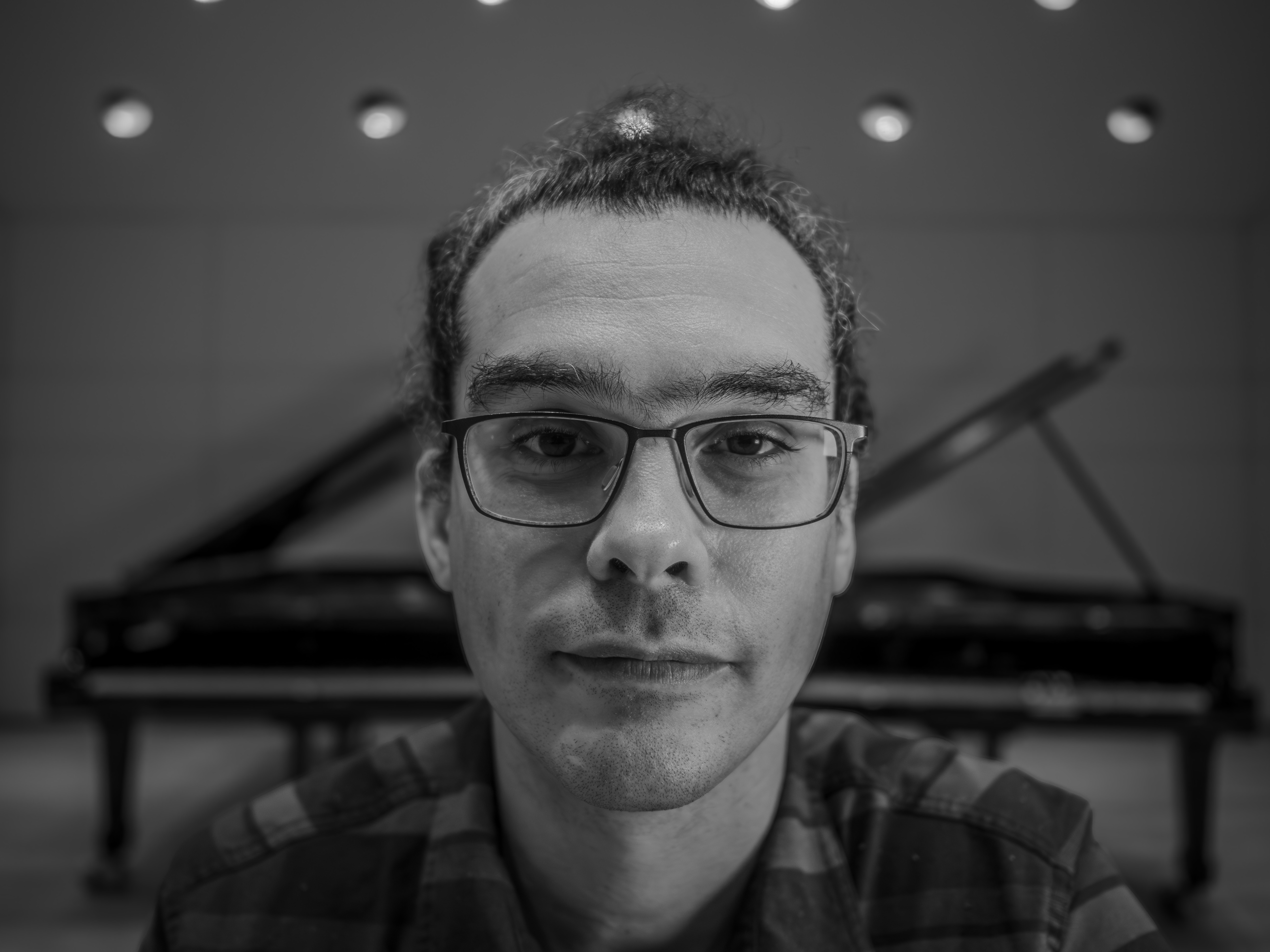
Fabian Almazan
Concert Description:
Cuban-American pianist and composer Fabian Almazan presents an evening of solo piano improvisation and multimedia performance, expanding the timbral range of the acoustic piano through live audio processing and synchronized video visuals.
Bio:
Cuban-American pianist/composer Fabian Almazan found his musical roots as a child in Havana where he first became involved in the classical piano tradition. Most recently, Almazan can be heard in such films as Harriet, Chi-Raq, Red Tails, and Miracle at St. Anna.
Almazan is the founder and director of Biophilia Records. The theory of Biophilia states that there is "an instinctive bond between human beings and other living systems." In addition to creating meaningful and imaginative music, Biophilia Records artists are united by a common interest in having a positive impact on the environment and our communities.
As a performer, Almazan has developed a personal voice through the electric manipulation of the acoustic piano in live and studio settings. He has toured his music extensively as well as accompanied artists such as Linda May Han Oh, Terence Blanchard, Gretchen Parlato, John Hollenbeck, Mark Guiliana, Dave Douglas, Avishai Cohen, and Ambrose Akinmusire, among others.
Awards include 2 Grammy nominations, the SWR New Jazz Meeting commission, the Copland Fund, the Jerome Fund for Emerging Composers Award, the Jazz Gallery Residency, Rockefeller Brothers Residency, Cintas Foundation Award in Composition, and the Sundance Composers' Lab.
Program Notes:
Several of the pieces heard tonight originated from my project, "We Call This Home." Growing up in South Florida, I became acutely aware of a deep stratification among the people and communities around me. This early realization of societal division eventually intersected with my enduring dedication to climate activism. The specific catalyst for these compositions occurred years later at a climate conference in Los Angeles. There, I first learned the term "sacrifice zones"—marginalized, predominantly minority neighborhoods forced to bear the brunt of highly toxic environmental hazards like garbage incinerators and chemical plants.
Realizing that the systemic segregation I witnessed in my youth directly mirrored these environmental injustices, I set out to document and interview residents on the frontlines of this crisis in South Florida. They expressed a fierce love and pride for their culture. Honoring their resilience, the project evolved into We Call This Home. The resulting music merges these ethnographic interviews with live performance.
Doral:
This piece centers on the predominantly Hispanic city of Doral, Florida, a community heavily burdened by the pollution of a massive local garbage incinerator. The composition integrates Doral residents and advocates from Florida Rising, including Gina Romero, Sebastian Caicedo, and Juan Carlos Esquivel. Underscored by the piano, their spoken accounts capture the tense duality of their daily lives: enduring the slow violence of toxic exposure while holding a deep, unwavering pride for their home.
A Spiritual Refuge:
Shifting from the urban environment to the indigenous wetlands, this work is a meditation on the profound bond between the Seminole people and the natural world. The composition is anchored by the voice of Samuel Tommie, an artist, musician, and elder of the Seminole Tribe of South Florida. Rather than framing the indigenous experience solely through the lens of historical tragedy, the music creates a space of resilience, using Tommie's words to bridge the deep sorrow of the past with the enduring sanctuary of the Everglades.
A World More Concrete:
Taking its title from N.D.B. Connolly's historical analysis of Jim Crow real estate practices in South Florida, this piece examines how racist urban planning laid the direct groundwork for modern environmental inequalities. We see and hear MacKenzie Marcelin, the Climate Justice Director at Florida Rising, in this piece.
Oh Yeah, Oh Yeah:
Taking a distinctly rhythmic approach to documentary audio, this piece transforms speech itself into music. Inspired by the pioneering multimedia techniques of jazz pianist Jason Moran, the composition centers on an interview between Al Gore and Dr. Robert Bullard, widely recognized as the "father of the environmental justice movement." By framing Bullard's spoken words with deliberate musical repetition and accompaniment, the piece allows his insights to land with a poetic weight, expanding our capacity to absorb urgent truths.
Sound and Spatialization by Alex Tung
Lighting by Perry Naseck
Concert Description:
Cuban-American pianist and composer Fabian Almazan presents an evening of solo piano improvisation and multimedia performance, expanding the timbral range of the acoustic piano through live audio processing and synchronized video visuals.
Bio:
Cuban-American pianist/composer Fabian Almazan found his musical roots as a child in Havana where he first became involved in the classical piano tradition. Most recently, Almazan can be heard in such films as Harriet, Chi-Raq, Red Tails, and Miracle at St. Anna.
Almazan is the founder and director of Biophilia Records. The theory of Biophilia states that there is "an instinctive bond between human beings and other living systems." In addition to creating meaningful and imaginative music, Biophilia Records artists are united by a common interest in having a positive impact on the environment and our communities.
As a performer, Almazan has developed a personal voice through the electric manipulation of the acoustic piano in live and studio settings. He has toured his music extensively as well as accompanied artists such as Linda May Han Oh, Terence Blanchard, Gretchen Parlato, John Hollenbeck, Mark Guiliana, Dave Douglas, Avishai Cohen, and Ambrose Akinmusire, among others.
Awards include 2 Grammy nominations, the SWR New Jazz Meeting commission, the Copland Fund, the Jerome Fund for Emerging Composers Award, the Jazz Gallery Residency, Rockefeller Brothers Residency, Cintas Foundation Award in Composition, and the Sundance Composers' Lab.
Program Notes:
Several of the pieces heard tonight originated from my project, "We Call This Home." Growing up in South Florida, I became acutely aware of a deep stratification among the people and communities around me. This early realization of societal division eventually intersected with my enduring dedication to climate activism. The specific catalyst for these compositions occurred years later at a climate conference in Los Angeles. There, I first learned the term "sacrifice zones"—marginalized, predominantly minority neighborhoods forced to bear the brunt of highly toxic environmental hazards like garbage incinerators and chemical plants.
Realizing that the systemic segregation I witnessed in my youth directly mirrored these environmental injustices, I set out to document and interview residents on the frontlines of this crisis in South Florida. They expressed a fierce love and pride for their culture. Honoring their resilience, the project evolved into We Call This Home. The resulting music merges these ethnographic interviews with live performance.
Doral:
This piece centers on the predominantly Hispanic city of Doral, Florida, a community heavily burdened by the pollution of a massive local garbage incinerator. The composition integrates Doral residents and advocates from Florida Rising, including Gina Romero, Sebastian Caicedo, and Juan Carlos Esquivel. Underscored by the piano, their spoken accounts capture the tense duality of their daily lives: enduring the slow violence of toxic exposure while holding a deep, unwavering pride for their home.
A Spiritual Refuge:
Shifting from the urban environment to the indigenous wetlands, this work is a meditation on the profound bond between the Seminole people and the natural world. The composition is anchored by the voice of Samuel Tommie, an artist, musician, and elder of the Seminole Tribe of South Florida. Rather than framing the indigenous experience solely through the lens of historical tragedy, the music creates a space of resilience, using Tommie's words to bridge the deep sorrow of the past with the enduring sanctuary of the Everglades.
A World More Concrete:
Taking its title from N.D.B. Connolly's historical analysis of Jim Crow real estate practices in South Florida, this piece examines how racist urban planning laid the direct groundwork for modern environmental inequalities. We see and hear MacKenzie Marcelin, the Climate Justice Director at Florida Rising, in this piece.
Oh Yeah, Oh Yeah:
Taking a distinctly rhythmic approach to documentary audio, this piece transforms speech itself into music. Inspired by the pioneering multimedia techniques of jazz pianist Jason Moran, the composition centers on an interview between Al Gore and Dr. Robert Bullard, widely recognized as the "father of the environmental justice movement." By framing Bullard's spoken words with deliberate musical repetition and accompaniment, the piece allows his insights to land with a poetic weight, expanding our capacity to absorb urgent truths.
Sound and Spatialization by Alex Tung
Lighting by Perry Naseck